
Memphis Historical Directory Holdings
Memphis has several paths into older listings, and each serves a different part of the search. The Shelby Register archive identifies a Memphis historical-directory title covering 1849 through 1943. Its notice also says some volumes are partial, including portions described as 1849 through 1923 and 1853 through 1856. The Memphis Public Library keeps old city and telephone directories, microfilm, and indexes. When an online result is blank, check whether the selected year, section, or scan is absent before deciding that a name was not listed.
| Collection | Years | Where Held | Access |
|---|---|---|---|
| Register archive directory title | 1849–1943 title | Shelby Register archive | Online directory, section, and alpha controls |
| Partial Register volumes | 1849–1923; 1853–1856 notices | Shelby Register archive | Check the chosen scan and its adjacent page |
| City and telephone directories | Years vary by volume | Memphis Public Library History Department | Local holdings, microfilm, and indexes |
| Census microfilm and indexes | 1790–1920 | Memphis Public Library | In-library historical household check |
A dated directory listing is strongest when its page heading, section, and nearby entries are saved together. A single name can appear as a household head, boarder, business contact, or widow or widower notation. The index is a lead, not proof that a person stayed at an address continuously.
Note: Save the selected volume and page number because partial scans and omitted sections can make a negative archive search misleading.
Memphis Archive Directory Controls
The Register archive is useful when a year and surname are already known. Its city-directory mode has a City Directory selector, a Section selector, and Alpha controls. Start with the exact surname in the likely annual volume. Then try initials, spelling variants, a business name, a nearby street entry, or a person named in the first hit. Keep a note of failed passes too. An unreadable scan, a missing volume, or an omitted section can explain a result that looks empty.
The Shelby Register city-directory selector shows the directory, section, and alphabetical controls used to narrow a historical volume.
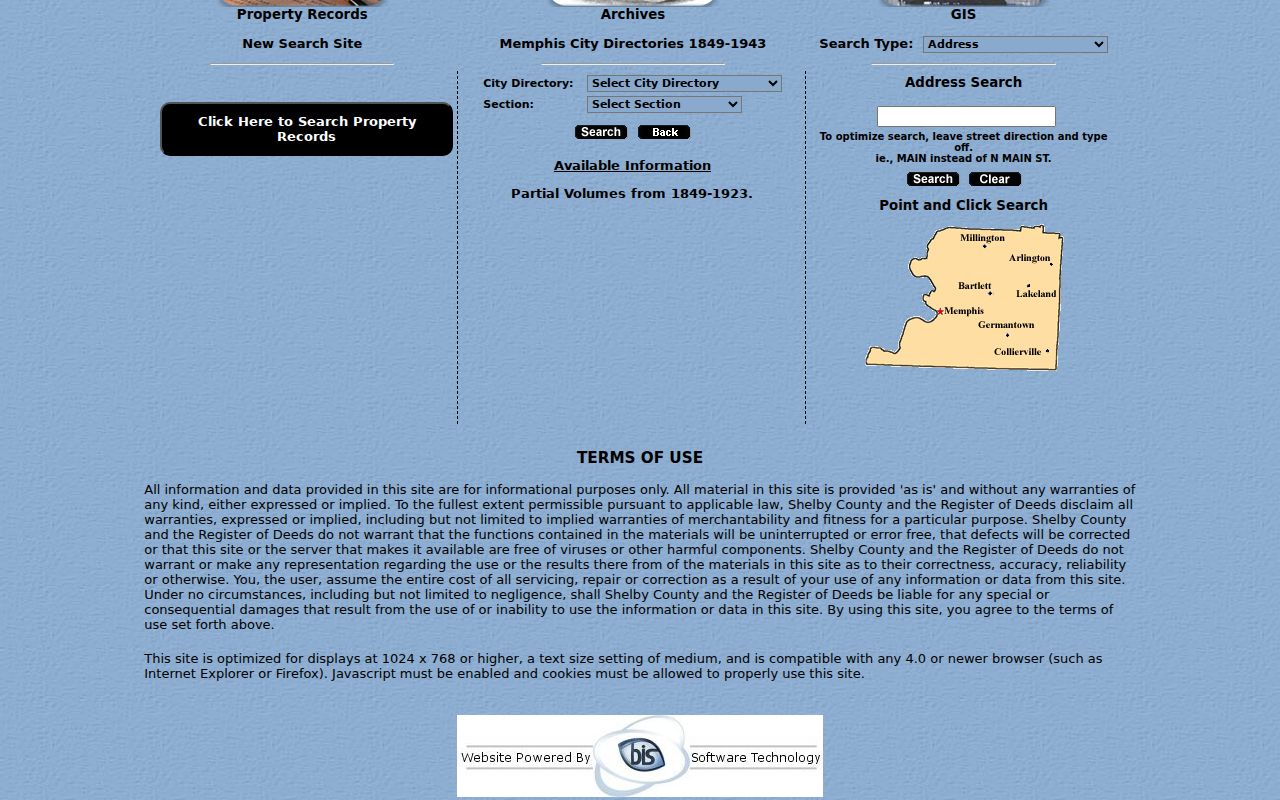
Once a listing appears, preserve the year, page, name, address, category, and one adjacent entry. The neighboring line can distinguish similar names or show whether a record belongs to a business block rather than a household.
Memphis Historical Directories at the Library
The Memphis Public Library History and Social Science Department is on the fourth floor of the Benjamin L. Hooks Central Library. Its Memphis/Shelby County Room holds books, maps, clippings, pamphlets, periodicals, manuscripts, oral histories, old directories, yearbooks, and more than 20,000 genealogy books. Staff and volunteers can help route a visitor to the right format, but the genealogy guidance says they do not conduct the research itself. Bring a surname, street, date range, source citation, and target volumes.
The Memphis Library genealogy and microfilm information documents the local-history research setting and its historical source ranges.

Library microfilm makes an important second route when the Register portal does not include a needed year. Record whether the evidence came from an index, a microfilm image, or another reproduction, since those forms do not carry the same level of detail.
Decode a Memphis Directory Entry
A Memphis directory entry may hold a surname, given name or initial, occupation or category, street number, street name, employer or business, spouse or widow notation, and a separate business listing. The field set changes by year and scan. Read the page header before drawing a conclusion, and use the volume’s own wording rather than expanding an abbreviation from memory. A listing supports the careful phrase “listed at” for that date, not a claim of ownership or permanent residence.
| Name form | Surname, given name, or initial used in that volume |
|---|---|
| Category | Occupation, business, or other classification shown by the listing |
| Address clue | Street number and street name, checked against the page section |
| Household clue | Spouse, widow or widower notation, boarder status, or household-head context when printed |
| Evidence detail | Publication year, page number, section, and adjacent entry |
- Alpha control
- An alphabetical grouping used by the Register archive to narrow the displayed directory material.
- Street section
- A part of a volume arranged around streets rather than a surname list, when that volume includes such a section.
- Abbreviation key
- A volume-specific explanation of shortened labels. Look for one before expanding an unfamiliar mark.
Entries change with the publisher, year, and scan quality. A category can describe a business relationship rather than a home, and a nearby street line can be more useful than a guessed expansion of shorthand. Photograph or save the page heading with the entry so the section and alphabetical context remain clear when the result is compared later.
Memphis Directories and Renumbering
Old numbers cannot be pasted into a modern map without a bridge. Memphis Library material gives a concrete example: the old 338 Main and Union corner became 77 South Main in 1905. A 1903 directory listed G. Edgar West, a dentist, at 337 Main over Security Bank. The point is not to match that historical listing to a current person. It is to search both number forms, the intersection, and the business name before deciding that an address trail has ended.
- 1903: A directory example places G. Edgar West at 337 Main over Security Bank.
- 1905: The Main and Union renumbering bridge links the old 338 corner to 77 South Main.
- 1912: A Leo Kahn listing at 352–354 Poplar shows why a business range can matter.
- 1919: Binghampton’s annexation cautions against applying a present city boundary to an earlier record.
Street names can also change. Memphis Library notes that Linden became Dr. Martin Luther King Jr. Avenue. Compare a directory page with a 1904 Faxon map, a 1925 local map, or a Sanborn sheet before inferring that an old number is the same parcel today.
Memphis Directory Clues Beyond Names
When a directory provides only a thin lead, Dig Memphis can add local context. The digital repository has 39 collections and can be searched by subject, time period, item type, and keyword. Its M Files, funeral programs, Orange Mound material, Cook oral histories, maps, and local image collections may surface a church, school, business, or event tied to a street. Collection material should be cited as context or a lead, not silently substituted for an official record.
The Dig Memphis collection search provides the subject, time, item-type, and keyword facets used for these companion materials.
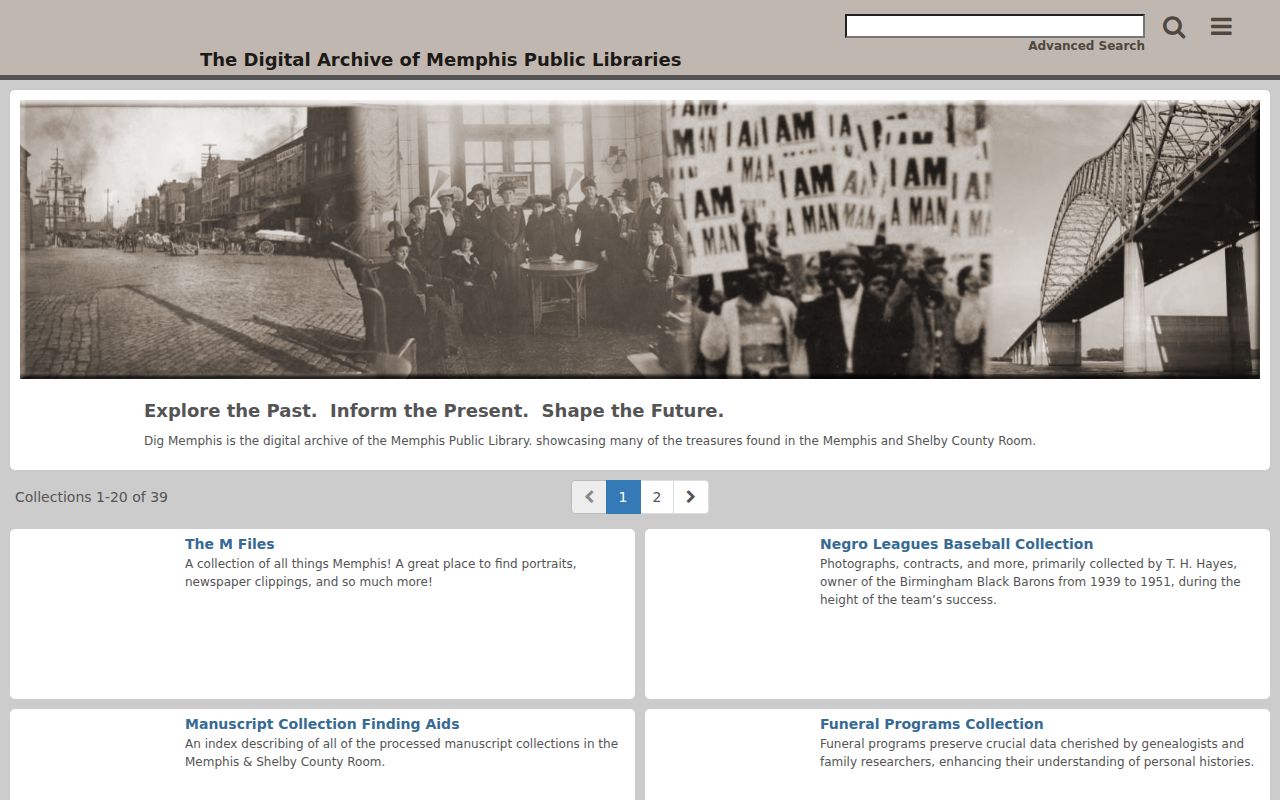
The Jones Family Boxtown Collection spans about 70 years and includes photographs, clippings, correspondence, church bulletins, and community material. The Arthur Webb collection adds correspondence, genealogy notes, clippings, and photographs from a local historian and genealogist. Check item metadata and permissions before treating either collection as evidence.
Trace Families in Memphis Directories
Following a household through adjacent years can narrow a move, a changed occupation, or a shift from an address to a business listing. Pair the annual volumes with the available U.S. census microfilm and indexes, which run from 1790 through 1920 at the library. Census material can add household composition, age, relationship, and adjacent households. It should be described as a person being enumerated at an address, not as proof of continuous residence.
- Find the earliest likely directory year and save the year, section, page, and exact spelling.
- Check the next available year, then record address, category, spouse or household clue, and nearby entries.
- Search an address under old and current number or street-name forms when a map or renumbering bridge calls for it.
- Pair the directory period with the nearest census year, comparing age, household composition, and neighboring names.
- Use an obituary, cemetery source, probate item, or newspaper notice only as a second dated source, with its repository noted.
A disappearance can mean a move, a missing scan, a name change, an unlisted boarder, or a death. The backward address workflow for Memphis past residents can then test a directory clue against the parcel and deed trail rather than assuming the first match is final.
Memphis Directories and Archive Companions
Some Memphis directory questions need a county record that is not a directory page at all. Shelby Archives lists an 1865 Memphis census, Memphis Police Blotter material from 1858 through 1860, Memphis Provost Marshal records from 1863 through 1865, naturalization records from 1856 through 1906, occupant and entry and survey books from 1819 through 1962, quarterly-court loose-paper indexes from 1820 through 1865, and cemetery, burial, aerial, and map material. These collections can add a ward, date, land relationship, military-era presence, or burial clue.
Start with the collection title, date, box or book reference, and repository instructions. The existence of a series does not mean every name is indexed or every image is open. Use an archive result to corroborate a dated directory entry, then describe its limits plainly. Early county bound-record series can have gaps from fire or lost volumes, so an absence in one file should be recorded as an access or coverage issue rather than a conclusion about a person.
What Memphis Directories Establish
These directories work best as dated evidence of a listing. They do not establish legal ownership, a complete household, or a person’s continuous presence. A person might be absent, boarding, associated with a business, or confused with another person of the same name. Compare a middle initial, spouse or parent, age, occupation, nearby entry, map block, and a second year before connecting records.
For a difficult case, use the repository that owns the format. The Register holds its index, library microfilm may supply an image, and a manuscript may require a finding aid or an appointment. The Germantown Regional History and Genealogy Center, University of Memphis Special Collections, and Tennessee State Library and Archives can fill regional or early-record gaps, but the exact collection and access channel still matter.
Note: Keep the scan page, search terms, access date, and any unresolved contradiction with every Memphis archival listing.